
The Induction Program of Semester 1 of 2026-2027
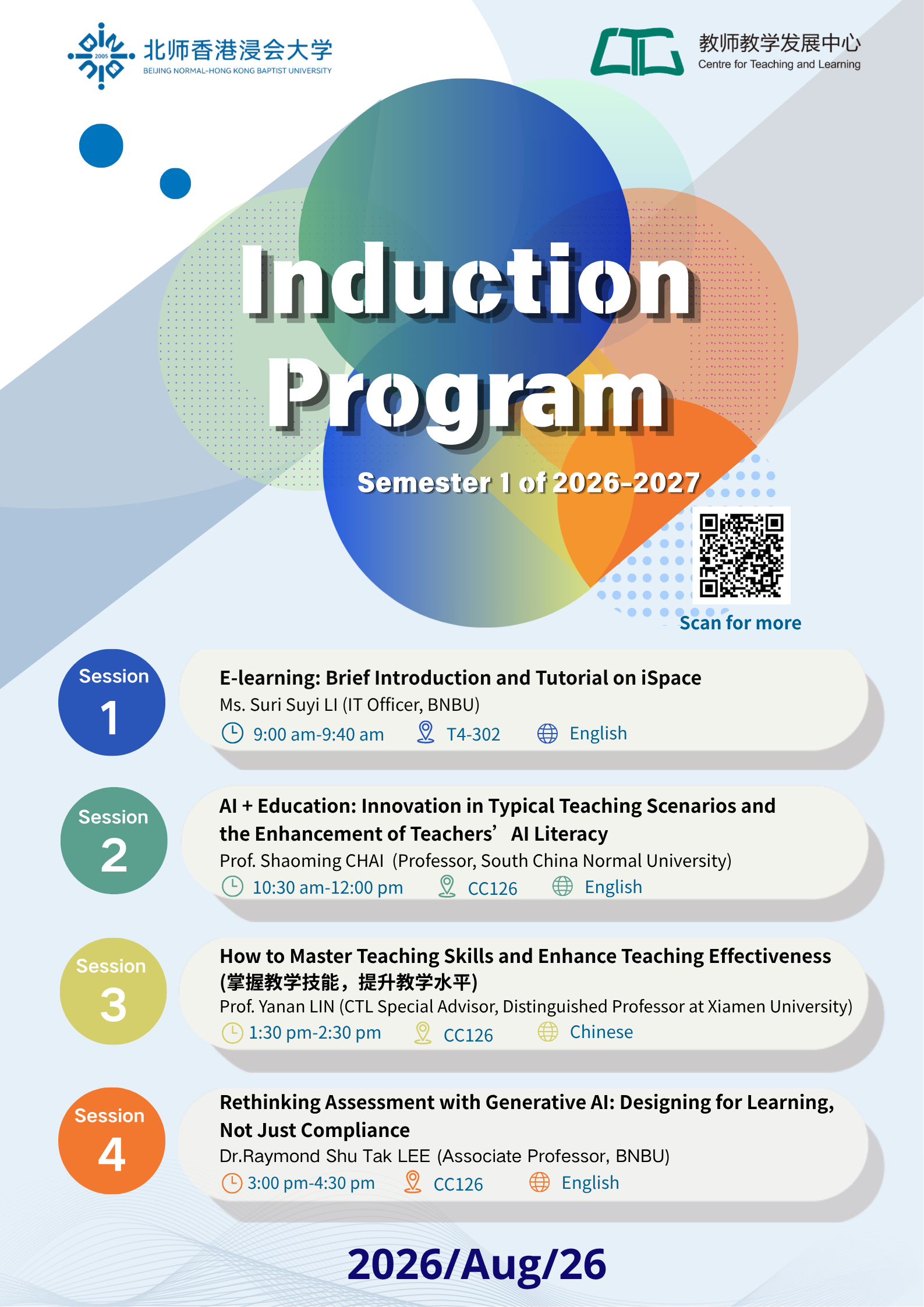
As we begin a new semester, you are cordially invited to our Induction Program for Semester 1 of 2026–2027, which will be held on 26 August 2026. Join us for a day of learning, sharing, and inspiration as we explore new possibilities for teaching and learning at BNBU.
This semester, we bring together renowned scholars and experienced practitioners from BNBU and other universities to share their expertise on effective teaching and the integration of AI in higher education. The program is designed to support all teaching and teaching support staff, particularly new hires, in developing their teaching practices. The workshop abstracts are as follows:
IP workshop 1: E-learning: Brief Introduction and Tutorial on iSpace
Co-organizer: Information Technology Services Centre (ITSC)
Time: 9:00 am-9:40 am.
Facilitator: Ms. Suri Suyi LI (IT Officer, ITSC, BNBU)
Language: English
Venue: T4 - 302
Abstract: This workshop provides a practical introduction to iSpace/Moodle, covering course preparation, navigation of tutorial resources, and access to support and contact information.
IP workshop 2: AI + Education: Innovation in Typical Teaching Scenarios and the Enhancement of Teachers’ AI Literacy
Time: 10:30 am-12:00 pm.
Speaker: Prof. Shaoming CHAI (Professor & Associate Dean of the Aberdeen Institute of Data Science and Artificial Intelligence, South China Normal University)
Language: English
Venue: CC126
Abstract: Prof. Chai's research focuses on knowledge building, collaborative learning, learning sciences, and technology-enhanced education. He has led and participated in numerous national and provincial research projects in the humanities and social sciences. He has published more than 30 papers in leading domestic and international peer-reviewed journals and has authored or translated five books. His course, Knowledge Building and Collaborative Innovation, has been recognized as a National First-Class Blended Undergraduate Course by the Ministry of Education of China. This lecture examines the pivotal role of AI in reshaping higher education, offering practical strategies for educators to boost their AI literacy. It covers AI-driven curriculum design, intelligent teaching tools, and innovative assessment methods, highlighting how AI can enhance student engagement and foster critical thinking.
IP workshop 3:掌握教学技能,提升教学水平 (How to Master Teaching Skills and Enhance Teaching Effectiveness)
Time: 1:30 pm-2:30 pm
Speaker: Prof. Yanan LIN (CTL Special Advisor, Distinguished Professor at Xiamen University)
Language: Chinese
Venue: CC126
Abstract: Prof. Lin is a Chen Jingrun Distinguished Professor of Mathematics and former Dean of the School of Mathematical Sciences at Xiamen University. He is a recipient of the State Council Special Government Allowance, a National Leading Talent under the "Tenthousand Talents Plan," a National Distinguished Teacher, and an Outstanding Teacher of Fujian Province. His Advanced Algebra course has been recognized as a National Excellent Course, a National Resource-Sharing Course, and a National First-Class Undergraduate Course, while his teaching achievements have received both provincial and national awards. The lecture will give valuable insights on mastering teaching skills and enhancing teaching effectiveness, including methods for refining lectures and course materials, integrating AI tools to enhance efficiency, and implementing student-centered pedagogy.
IP workshop 4:Rethinking Assessment with Generative AI: Designing for Learning, Not Just Compliance
Time: 3:00 pm-4:30 pm.
Facilitators: Dr.Raymond Shu Tak LEE (Associate Professor, Faculty of Science and Technology, BNBU)
Language: English
Venue: CC126
Abstract: Generative AI is reshaping how students access, process, and produce information—but what does this mean for how we assess learning? This session explores the pedagogical and design principles that can guide BNBU educators in responding thoughtfully to this shift. Rather than focusing on specific AI tools, we will delve into the architecture of assessment: How do we design tasks that remain meaningful, authentic, and rigorous in an AI-rich environment? How do we balance academic integrity with the responsible integration of AI as a learning partner? Participants will examine frameworks for creating assessments that prioritize critical thinking, process-oriented feedback, and real-world application. We'll discuss practical strategies—from transparent rubrics to multi-stage assignments—that uphold learning outcomes while adapting to new realities. Grounded in BNBU's educational context and drawing on examples from the induction materials, this session aims to equip educators with a reflective mindset and actionable design templates for assessment that enduresbeyond the AI hype.
We warmly welcome all teaching and teaching support staff to join us for a day of learning and exchange. We look forward to seeing you on 26 August!
Last Updated: August 18, 2026